
The Shift in Globalization
In the early 2020s, expanding globally was relatively straightforward. Translation agencies and basic workflows were often sufficient. By 2026, this approach is no longer viable.
Modern digital systems require real-time, context-aware communication across regions. However, large language models can translate text but do not solve the broader architectural challenge. Effective globalization now depends on building systems that manage accurate, bidirectional communication across markets such as North America, Europe, and the Middle East.
Global reach is no longer a language problem. It is an infrastructure problem. In practice, most systems fail at this stage.
Challenge 1: Bi-Directional Systems and RTL Support
Expanding into RTL (right-to-left) languages introduces structural challenges beyond translation. Interfaces must adapt fully to directionality, not just content.
Solution: Direction-Agnostic Front-End Design
Build front-end systems to support both LTR and RTL from the start. In practice, this includes the following:
- CSS logical properties instead of fixed directions.
- Flexible layout systems (e.g., Flexbox, Grid).
- Automated testing for layout validation across locales.
Embed localization in the architecture from the start.
Challenge 2: Contextual and Cultural Accuracy
Translation alone does not ensure relevance. For example, communication styles differ between markets such as Riyadh, Berlin, and Brussels.
Generic AI outputs can introduce inaccuracies or inappropriate tone, which can affect brand perception.
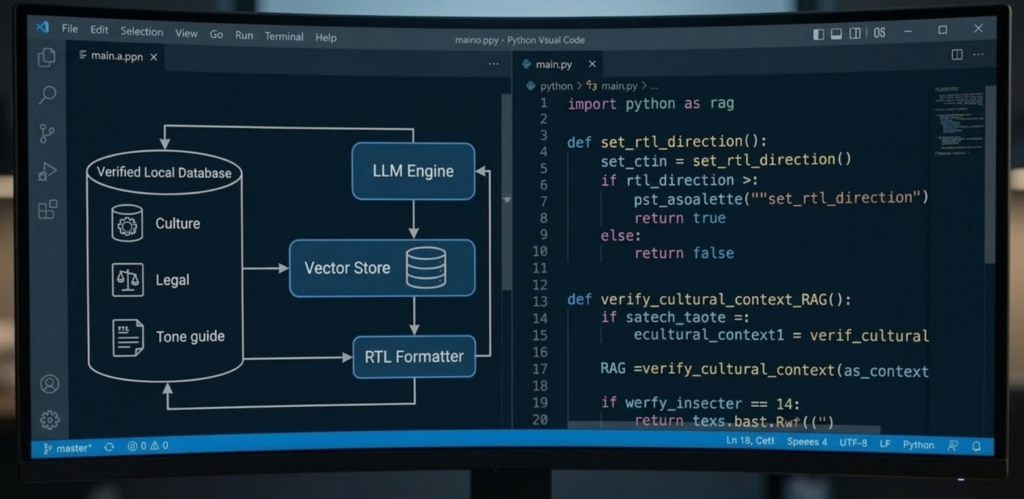
Solution: Retrieval-Augmented Generation (RAG)
RAG improves accuracy by grounding AI outputs in verified data sources. As a result, responses remain aligned with both factual data and regional expectations.
- Structured knowledge bases (product data, terminology, guidelines)
- Region-specific cultural rules
- Controlled retrieval before response generation
This keeps responses consistent across regions.
Challenge 3: Scaling Content Operations
Content volume has exceeded the capacity of manual review. Automation is required, but unverified automation introduces quality risks.
Solution: Continuous Localization Pipelines
Localization should follow principles similar to software delivery:
- Version-controlled content
- Automated testing workflows
- Continuous deployment pipelines
Automated QA Layer
Quality assurance must be integrated into the pipeline:
- Linguistic validation (grammar, syntax)
- Cultural validation (tone, regional fit)
- Pre-deployment checks to prevent user-facing errors
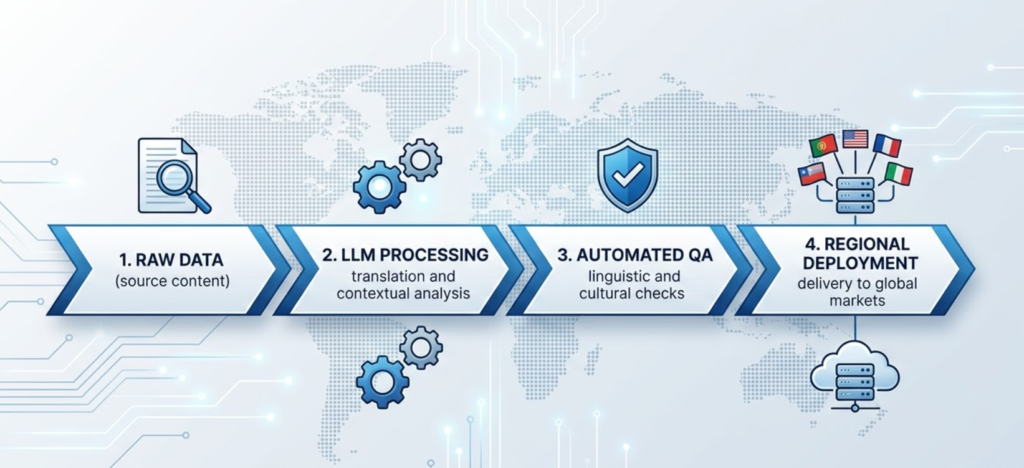
Reference Workflow
- Content Creation: Original source material is produced.
- Automated Translation: Managed via specialized LLMs.
- Linguistic QA Bot: Checks grammar and syntax.
- Cultural QA Bot: Checks for tone and regional context (grounded by RAG).
- Final Deployment: Automatically pushes the verified asset live.
Conclusion
Globalization in 2026 requires deliberate engineering. Ultimately, Systems must be designed to support directionality, contextual intelligence, and automated quality control from the outset.
Organizations that treat globalization as a core technical capability—rather than a translation task—will achieve consistent, scalable, and reliable global experiences.
This is where many implementations break down.